
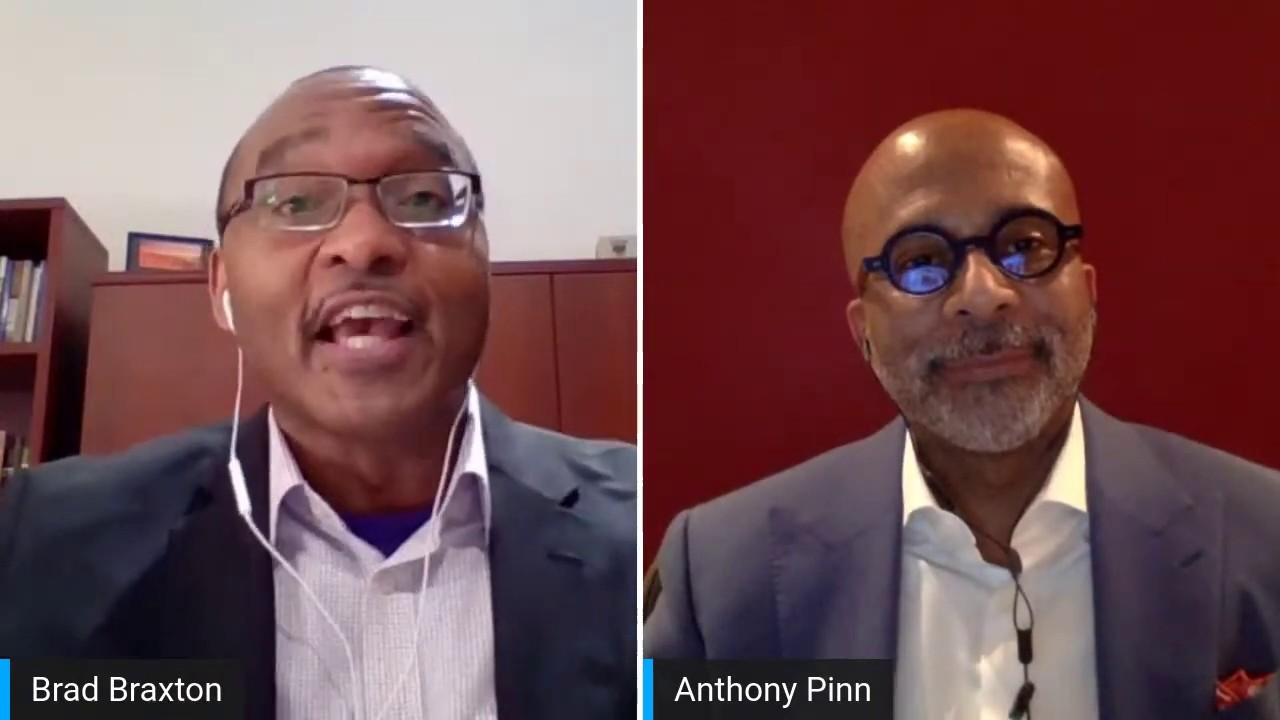
[MUSIC] >> DR. BRAD BRAXTON: Welcome to “Reconstructing Hope: Black Religions in the Age of Black Lives Matter,” a part of Beyond the Mall from the Smithsonian Folklife Festival. Thank you for joining us. We are offering real-time captioning and American Sign Language interpretation for today’s program. To view the simulcast that includes these services, please use the link provided in the comments section.
My name is Dr. Brad Braxton, and I’m the curator for living religions at the Smithsonian Folklife Festival. Today we invite you to participate in conversation that explores the roles of diverse African American religious and ethical traditions and affirming that Black lives matter. We want to grapple with whether and how these religious and ethical traditions might promote restorative justice and indomitable hope. We’ll be taking your questions and comments in the chat, so please participate.
This event is supported by the Smithsonian Folklife Festival and is a preview of the 2022 Folklife Festival program, “Creative Encounters: Living Religions in America”. We are especially grateful to the Lilly Endowment for its generous underwriting of this creative venture. If you do not know the Festival I encourage you to check out festival.si.edu to learn about our programs, educational resources and more.
Now I want to welcome our guest, my dialogue partner and my friend, Dr. Anthony Pinn. >> DR. ANTHONY PINN: Brother Brad, it’s a delight to be with you. >> DR.
BRAD BRAXTON: Thank you. Anthony, these are very challenging times. Over and over again we see episodes of anti-Black violence. Literally and figuratively, individuals and communities are in a chokehold. Whether that is applied through the knee of a rogue police officer or mean spirited public policies that asphyxiate dreams or unfairly incarcerate Black people or undocumented persons in detention centers.
In these days when hope is under assault, I am reminded of those poetic musings, Tony, of James Weldon Johnson who in an earlier manifestation of the Black Lives Matter movement in the Jim Crow South, penned a poem that would become the Negro National Anthem. You know these words so well. Perhaps it’s a good place for us to start. Stoney the road we trod. Bitter the chastening rod.
Felt in the days when hope unborn had died. Yet with the steady beat have not our weary feet come to the place for which our fathers and mothers sigh. Tony, as a scholar of Black religions and a member of the Humanist community, talk with us about hope. What are the meanings and nuances of hope? >> DR.
ANTHONY PINN: That’s a fantastic question and let me start with a bit of context from my perspective. In those haunting lyrics it seems to me is a call to memory. So while we might say, and it is true, that these are challenging times, they are not unfamiliar times. We are not talking about a scenario in which violent disregard of Black bodies is just beginning to surface. What we are seeing is this violent disregard in real time.
And so it seems to me the moment calls for us to rethink not only our strategies of activism, but to rethink the vocabulary, the grammar, we make use of to describe our circumstances and to push against our circumstances. I think we would both agree that comfort short circuits the construction of justice. So we have to push beyond comfort. It seems to me one element of that push beyond comfort is to interrogate this category of hope. From my vantage point, it’s a term that no longer serves a vital function.
That it is too future driven. And so rather than talk in terms of hope, I would much prefer that we center on — in our collective thinking, center on perseverance. Highlight perseverance as a way of getting at how we address the current moment from within that current moment. >> DR. BRAD BRAXTON: You raise a wonderful notion of the grammar, the language that we use to deal with our present realities and to try to move through them to whatever is on the other side.
When I think about hope, where I first enter into the conversation is perhaps a willingness to want to hold on to the term, but to invest the term with all of its robust significance. So in terms of the memory that you call us to, I’m reminded of the memoir of Dr. Samuel Proctor, who of course was one of Dr. King’s mentors, and who in large measure was responsible for King going to Boston University. It was as many of us know, a college president during the sit-ins in the ’60s.
And Dr. Proctor talked about growing up in the Jim Crow south in Virginia. And he said that the difference for them as children was that in those classrooms to use a grammatical term, the educators, the teachers, the mentors, spoke often in the subjunctive mood. In other words, the mood of possibilities. So while at one at the same time taking seriously the notion of perseverance, there was this sense that the brutality of the present could not ultimately swallow the beauty of the future.
But what I’m hearing you say, Tony, is we cannot turn away from the brutality of the present. Even as we may be thinking about what opportunities there are on the other side of that. So for me, I want to hold on perhaps to the term. But interrogated, as you’re calling us, and look at it in a way that holds onto both the brutality but the ability to lean and say there may be some beauty forthcoming. >> DR.
ANTHONY PINN: So let’s chat about that for a minute. And so there’s much of what you say that I have no choice but to agree with. That we both are situated in — have drawn from, have been nurtured by a long tradition that sought to recognize the brutal nature of white supremacy. But also safeguard a sense of the beauty, the value of Black personhood. Right?
And so what I’m calling for us to do is to recognize on one level the ongoing and tenacious nature of this disregard. And to do that in a way that allows us to more fully confront the possibility of failure. So this is the key for me. If we can come up with a way of thinking about hope that holds to a different posture towards the work, I’m with that. But it seems to me what we have at this point is an ongoing reliance on outcome-driven strategies.
We labor because we know we can win. We do this work because we know persistent work. And if you’re a Black Christian, consistent work, accompanied by a God that is deeply committed to this work. Will produce the desired outcomes. But how then do we wrestle with the persistent nature of this disregard?
It’s genius is its ability to warp and to shift and to change. To surrender something. To maintain its larger integrity. So how do we do this work in a way that recognizes the feasibility of failure? And so what I’m suggesting, underlying my call to re-evaluate the utility of hope, is a call for us to privilege process-driven strategies.
Not what we will achieve. But what we can do now. And to recognize that in the current moment, it is feasible that all we can do is muster a profound and loud no to injustice. Recognizing that the victory may simply be the persistent nature of our no, as opposed to radical change. >> DR.
BRAD BRAXTON: When you call us to move to this place of thinking about process but not outcome, what leaps into my mind and my heart, especially coming from the best traditions of a kind of radical African American Christianity, and that’s a whole conversation we can have perhaps as time goes on there are other Christianity’s as there are other ethical traditions and some are indeed pathological, we need to be able to say that in an unflinching way. But the best of that tradition as I have understood it, has to your point helped me to understand hope not in terms of piety. But hope, rather, in terms of politics. That I actually think that piety, as it is often mediated in the traditions that I know, gets in the way of the kind of robust radical truth telling and facing of the realities of the moment for which you are calling. So for example, what comes to my mind is the reality in the Christian grammar that struggle with imperial and occupying forces is tenacious and it will marr you, it will bruise you, it will lead you perhaps to state-sponsored execution.
And that sense of in the face of that can we call forth the values that allow us to face that with unflinching, to use your term, faith, which of course, if faith be faith, in means of necessity failure must be an option. Any construction of an ethical project that claims to be faith saturated that does not make room for failure, even ultimate forms of failure is not really faith. So what I’m wrestling with as I hear you that’s really inspiring is how even within the traditions that feed us and that we are at times very critical of can we find those North Stars that may be places to help us in this reconstructing hope? So for me it’s about politics. It’s about the radical analysis of the power structures of the day.
And the values that allow us to go through the process to engage them fiercely. >> DR. ANTHONY PINN: Uh-huh. >> DR. BRAD BRAXTON: Even if, as you say, all we’re doing is continuing to say no.
>> DR. ANTHONY PINN: Yeah, as my grandmother would say, that’s more than a notion. And to do that in a way that allows both theists and non-theists to labor together becomes quite a challenge. And my argument would be both theists and non-theists, have made modes of engagement and interpretation that matter to us we have used modes of engagement that have privileged winners. So let me give you an example.
I don’t think we spend a whole lot of time talking about Nimrod. We certainly don’t spend a whole lot of time talking about Job’s wife. We talk about Job getting more stuff. But what would it mean to think about our moral and ethical framework from the perspective of those we have typically despised. That is to say those who have not been labeled winners.
So what would it mean to rethink community, solidarity. Privileging Nimrod. Or what would it mean to center human agency, human vulnerability, centering not Job, but Job’s wife? So again, my argument is that this vocabulary, our grammar, is tainted by assumptions we should not be making. One, it’s tainted by the assumption that the proper way to read is from the vantage point of the winners.
And we ought to know better than that. >> DR. BRAD BRAXTON: Indeed; indeed, we ought. And let me, as a way of moving deeper into this conversation lift up a comment and question that has come to us in the chat. And that is, are there — or is there room for other religious traditions?
I’ll just give a quick shoutout and then respond and then I know, Tony, will have a lot to say about that. Absolutely, unequivocally, yes. So that even in the construction of this program, the S on Black religions is meant to do a whole lot of work. I believe that Tony and I may from time to time touch down on particular traditions which with we have had considerable engagement. But I think there is a really wide openness and needs to be in this moment.
To all of the religious and ethical traditions, both to engage their upside as well as their underside. What I like, Tony, about what you have done as you talk about religious and ethical traditions and the text — and I know we mean that broadly. Not just kind of scriptural text quote-unqoute. >> DR. ANTHONY PINN: Right.
>> DR. BRAD BRAXTON: But the broad resources. And that even as I like to say, our bodies are texts. And one of my critiques is that many religious traditions and Black religious traditions sometimes, do not take seriously the living text of our bodies. And the emancipatory claims that our bodies make.
So that while certain text may say things about, for example, oppression of women and actually sanctifying that. Or where those particular texts may offer very unfortunate and horrific characterizations of gender nonconforming people or LGBTQ people, I have been converted over and over again to radical inclusion. And to this move for restorative justice. By the living text that have walked with me and taught me. And I think the other thing I would like to enter in and this is really a call for many in my own tribe, this priestly class.
Those of us who are authorized religious leaders, to your point, must relinquish as you indicate in one of your books, Tony, the logic of domination. So much of what we do is about domination so that we can shake a prophetic finger when we’re on the wrong side of that. But so quickly replicate those very dynamics in the communities that we are trying to create. So I want to certainly say yes, there’s plenty of room. We need all of the moral, ethical, sacred help we can get from the traditions.
And we need to relinquish our fetish with the logic of domination. >> DR. ANTHONY PINN: I would agree. And it seems to me if we are honest about, for example, the history of African American engagement, and what becomes of the United States, we have to acknowledge that it has never — it’s never been just Christianity. That there have always been competing faith claims that have guided moral and ethical perspectives.
And I think it’s correct, we do need to give much more consideration to these other traditions, these other vantage points, beyond the nod in the direction of Malcolm X. That this becomes vital. That is absolutely correct. There are more than Christians, there are more than atheists in the Black community. We need to think through that.
It seems to me part of the value in that exercise is the way in which it forces us to rethink our approach to difference. That we have often followed on the heels of the dominant approach to difference. That is to understand difference as a problem to solve. As opposed to recognizing indifference opportunity. And so on one level it requires giving consideration to the various forms of engagement that have marked Black lives geography.
And from that engagement, thinking through a vocabulary of grammar that speaks life in expansive ways. And for a larger range of folks. >> DR. BRAD BRAXTON: Yes. As we talk about this notion of hope and as you and I have prepared for this program I know to your earlier point that we do value that Sankofa backward glance going back to reclaim some things in order to move forward.
Whatever moving forward might mean. And you just reminded me of an assertion that Du Bois made and then Henry Mitchell, another historian and practical they’ll lodge January lifted so prominently in his text and that is this notion that even when we talk about Black churches, Du Bois and others reminded us that it took those traditions almost 200 years to become Christian. In that, right, there was this colonial overlay. And underneath it was all of this vibrant African traditional religion and cultural manifestations that in fact helped to influence, I might argue also convert, the worst manifestations of colonial Christianity. And I would also say I wrote in a book a few years ago it was a throw-away line and I was really trying to pick a fight and the line says that the first place that Black folks met God or encountered the sacred, however we define that, was not at the foot of the cross.
So part of my journey right now as an intellectual abolitionist and as someone deeply committed to the Black Lives Matter movement and a father of a 14-year-old emerging social activist daughter, I’m very, very interested in opening up the pantheon of resources that can help us. >> DR. ANTHONY PINN: Most definitely. That is absolutely necessary. You mentioned Du Bois.
And so I would like to go to him for a moment. And I’m paraphrasing now. But before Du Bois leaves the United States, he says to a friend, chin up, fight on. Knowing the Negro can’t win. Knowing the Negro can’t win.
And so it seems to me that statement, from my vantage point, is important. Because again, it pushes against the assumption that the only viable strategies are outcome-driven strategies. We need strategies that understand and privilege the current moment and our ability to say no to injustice within the context of the current moment. And in terms of resource, the question becomes the various traditions, the various philosophies of life found within African American communities, for example, what do they lend us that help us to re-envision, rethink, embrace the moment and come to grips with the possibility of failure. >> DR.
BRAD BRAXTON: Here is what I would like to do. I want to bring in another question that has come and I think it might offer us an opportunity to wrestle with this very generative tension I see in our articulations between the no and the yes. And my sense is that both of us are very open to the ethical power in the no and the yes. It may just be a matter of emphasis we’ll see as we continue to sort this out but someone — Jan on Facebook has asked us, how do you think Black religions define hope in ways that move us forward? Here is the way that I would articulate a response as a way of, Tony, inviting further reflection from you in this tension between the yes and the no.
What I find to be most helpful and if you’ll let me hold on to the term hopeful. [Chuckles] >> DR. BRAD BRAXTON: Is an experience that I’m living right now that comes out of the best of the kind of Black religious traditions that have formed me. And that is this notion of at a point a few years ago I was very strident in my critique about all of the pathologies of religion. And particularly Black religious traditions like the rampant sexism and patriarchy.
Just the incessant homophobia and heterosexism. I’ve been on record saying many days many Black churches I know have to spend at least 30 days in hell whatever God is going to do on the other side of that to just get themselves right and purify. I’m on record saying a lot of this. And yet one of my mentors at one point said, I can’t hear you say no more one more time. I can’t hear you talking about resisting that which is wrong.
I need you now to go build the alternative. And I think you and I may be saying something similar. Because this may be part of your process, not just the outcome. But across the last almost nine years I’ve been with a marvelous group of focus in Baltimore engaging with the creation of a radically inclusive faith community sacred space where we take seriously Buddhists dialoguing with Baptists and Humanists with Hindus and I’m glad you’re going to drop by and shed some light and drop some knowledge on us in a couple of weeks. but what I’m talking about is maybe Tony to this notion of process but in this moment where there’s a lot of rhetoric of being anti-racist which I completely get and understand, what I’m also wondering is, is there some ethical strength for the work by articulating what we are for.
By even in echoic ways building the alternative. And what I’ve discovered in these nine years is that that construction project as Secretary Bunch said in the opening comments, the Beloved Community does something to you. It’s actually more rigorous at times. So I wanted to offer that the religious traditions I know say something about hope because they do say, what are you going to build, even if the building project remains always incomplete how might you respond to that notion of this anti-racist language that’s very prevalent and very helpful. But also the yes that may be contained in trying to construct the Beloved Community or at least look at the blueprints for it.
>> DR. ANTHONY PINN: Yeah, let me preface it by saying I’m a Humanist and this is a tradition that for me tends to be too optimistic, too certain, much too certain. And that makes me uncomfortable. Because I think one of the things of value within our philosophies of life, whether it be Christianity, whether it be Ethab [phonetic] whatever it is, one of the values there is the way in which it exposes us to the presence of the gap. The distance between where we are and our well-being.
That moment of uncertainty that nothing fills that at its best this is what it does so it seems to me what we have to do across these traditions is privilege a particular mood and that’s a mood of humility and vulnerability. A recognition of the ways in which we contribute to the very problems we say we want to resolve. So I want to agree with you, Brother Brad on some level, but it needs to be qualified because I’ll say this, I don’t think we know what liberation looks like. So we’ve got to get there by negation. We know it can’t involve an environment in which homophobia is unchallenged racism is unchallenged gender bias is unchallenged ageism is unchallenged classicism is unchallenged.
We know what it doesn’t look like. But I’m not convinced based upon the few traditions I’m if a with we have a good sense of what it is — what it does look like. Our certainty on that level, take the Black church for example, has allowed us to overlook a graphic and death dealing sexism and homophobia because we know what it looked like and it looked like the end of racism. So again what I’m suggesting is a greater sense of vulnerability and uncertainty. An embrace of the question mark.
We don’t know what this looks like. Because we don’t have experience that speaks beyond our experience. So we don’t know what liberation looks like. We don’t know what transformation looks like. But we do have a good sense of the kind of pain and misery it cannot involve.
>> DR. BRAD BRAXTON: Yes; yes. Let’s continue playing jazz with this as we bring in another question from the chat. Here is this question: What do we say to the nuns and spiritual, but not religious? Many have backgrounds in religion, but find their religion in the movement itself.
What would you say to our friends who self-define in that way, Tony? >> DR. ANTHONY PINN: This growing group of the unaffiliated, we’re still trying to get — to wrap our minds around this group. They are not all Humanists, they are not all — they occupy spaces that we have traditionally had a difficult time bringing together so for example some of these folks understand themselves to be spiritual and atheistic in orientation. We have had difficulty prior to them being public about their understanding tying together these sorts of perspectives, opinions, and postures.
So we’re still trying to get a handle on what — what kind of orientations this entails. We do know, for example, within the Black community, it’s a growing population that is looking for modes of belonging. Looking for community beyond the traditional frameworks. I would also say, though, that it seems reasonable to understand that within the context of Black church tradition, there is within these congregations Humanists and atheists. Free thinkers hiding out.
In part because Humanists and atheists have been very good at critiquing theism. But haven’t really offered folks a soft place to land. A way to think about hope outside of the confines of the theological orientation they are trying to move away from. Good at critiquing the stuff, but not very good at providing an alternative. So my argument would be within the context of churches, you’ve got some folks who find community.
They don’t have to explain why they are angry. They don’t have to explain why they appreciate themselves. And if the theological orientation is the price they pay, they are more than willing to pay it. So within the context of churches you have this diverse and complex range of thought outside within this new category of the unaffiliated, you have this college range of thoughts. The question becomes, how do we develop a way of speaking and doing that allows us to cut theological orientations and provide something that is publicly compelling?
>> DR. BRAD BRAXTON: Yes. It’s marvelous the way in which this conversation around vocabulary and grammar and ways of even configuring inviting dialogue keeps running through our conversation. I would say this, and pick up something that you said that so in — that so inspired me again around this process and a keyword that needs to be entered into the dialogue. And that is the word humility.
And along with that, I would couple that when talking about those who are spiritual but not religious and the various manifestations of that. I would talk about the understanding of the term spirituality. I will never forget when a colleague at Wake Forest University a Benedictine monk reminded me of something from my training and classical languages that I knew but never heard it so simple he said spirituality you know, Brad, comes from the Latin word spiritis which simply means wind or breath. What I have found, for example when I was leading the Center for the Study of African American Religious Life at the Smithsonian National Museum of African American History and Culture and talking to lots of religiously diverse people what I found Tony to be very compelling when I would give tours in that beautiful building that I call our nation’s temple to freedom I would discover using language for accountability of breath is inviting. It doesn’t have to necessarily be transcendental or theistically oriented.
It’s the sense of we are stewards of a life force and we must — whether that is just to one another, our tribe, we must give an account, here is your process, of how we use our life force while we are here. So for me I think, again, there’s this opportunity to reach for language. Sometimes that may be inherent in the tradition. And sometimes may come from other places that invite us to think about common experience. >> DR.
ANTHONY PINN: Yeah. >> DR. BRAD BRAXTON: The notion of my life force has value. It is not just mine. It must be put in service of others.
Might be an ethical claim that I might make. So again, the vocabulary is important to creating the kinds of coalitions that I know you and I are interested in building. >> DR. ANTHONY PINN: Yeah. mean, I like that, Brother Brad because on one level it pushes us to dig deep.
Right? To kind of move beyond superficial acquaintance and look deep. Are there points about which we agree? Is there a kind of general mood or posture towards the world that we can all make use of. And so you know it’s — regardless of what some might think, it has not been my mission to padlock churches, mosques and synagogues.
Right? My goal is to decrease the harm that theists and non-theists and non-theists do in the world. And so I’ve wanted to think about that in terms of our action. But again, as we’re talking about it now, I also want to do that in terms of our vocabulary, our language, our grammar. How we describe our circumstances and our need.
And so this is the question. And I think it underlies what you’re getting at, as well. If our fundamental concern is the transformation of circumstances so as to produce possibility for profound life, what are we willing to give up? >> DR. BRAD BRAXTON: Yes; yes.
>> DR. ANTHONY PINN: Right? What are we willing to give up? In order to have opportunity to push for what we say we want. And I don’t think we’ve spent enough time wrestling with that question.
What are we willing to give up? We have tried to simultaneously preserve tradition. And push for transformation. And I don’t know it’s always feasible to do both. >> DR.
BRAD BRAXTON: And that call to a certain posture and ethic of relinquishment, you also get at the center of power. Because so much of this is, right, this tricky way that at one and the same time we deprive power and yet when its in our employ it’s often not used with the same kind of moral integrity that we’re calling for in those who are oppressing us. It’s very tricky territory. And that’s why the call for humility is so very important. >> DR.
ANTHONY PINN: And I think it’s key — it’s also key to recognize that those vocabulary has to address, it has to name, rather, tricky circumstances. So I would like to go back to Du Bois again. Not that he is the only one worth talking about. But I would like to go to Du Bois again. And in so as a Black Folk, he notes two problems, one is the Negro problem.
We might think of that in terms of the socioeconomic and cultural issues that unfree Black Folks have encountered we talk about in changing policies and economic opportunities, reparations. But there’s another question that Du Bois says is pressing but never really gets asked. And it’s this question, how does it feel to be a problem? And with that it seems to me Du Bois is naming the way in which Black Folks have from the very beginning been associated with death. We have not been fully regarded as alive.
Right? That life is part of the privilege that comes with whiteness. And Blacks have been represented as everything that is a threat to life read through whiteness and safeguarded through white privilege so we have to develop a way of speaking, of communicating, that recognizes the tangled nature of these two questions. And for us, the challenge today is, does hope figure into that vocabulary? >> DR.
BRAD BRAXTON: So let’s take another question, and this might be our last one given where we are with time. Marilyn writes this observation, in light of this discussion, there’s still the problem that when the battle is over, there is the unequal relationship. There’s still the oppressed and the oppressor. I’ll start — I’ll just wade quickly into these waters and let you have at it, Tony. What this observation brings forth in my mind is the earlier comment that I made about this logic of domination.
And that while, if we were to take seriously your articulation that we may not know liberation, what it means yet, we may not have gone sufficiently far enough to articulate that with real power, let alone precision, there is a sense in which whatever liberation might mean, it is the attempt to obliterate these categories. Right? These suffocating binaries. And to begin to engage life more in a kaleidoscopic way to talk about this difference, that is in the world, is not to Du Bois’ point, a problem. But actually is replete with ethical possibility.
So I think in the observation, the notion of oppressed and oppressor remaining is yet the call to engage systems, ways of thinking, cultural productions, that constantly have to divide the world into earlier language, winners and losers. >> DR. ANTHONY PINN: I think Marilyn is onto something. But I would think about it differently. We’re not sharing all of the same assumptions.
So for me, it is never over. It is never over. As long as humans populate this world, it will not be over. Now, I understand that some focus may say, okay that’s Pinn being annihilist again so we’re just going to throw up our hands and do nothing? No that’s not what I’m saying at all what I’m offering is a proper posture towards this is perpetual rebellion.
The understanding that we will always have to struggle against injustice. Always. Again, for me, this is a push beyond outcome-driven strategies. And a privileging of our effort to say, no, perpetual rebellion, we will always have to struggle against poor behavior. Disregard, death-dealing circumstances.
Always and forever. >> DR. BRAD BRAXTON: So Tony, when we do this again, and I hope that our friends at the Smithsonian will allow us to do this again, here is the place where I just want to offer this concluding note. And given a conclusion and give a few words of gratitude on our way out here. What I am compelled to say in response to Du Bois’ question about what does it feel to be a problem I do think the extraordinary religious ethical spiritual genius of Black people in the face of grotesque inhumanity is something of a response.
One of the characteristics if I may merge the text of Black experience with the text of the Apostle Paul I’m a Biblical scholar I’m struck by what Paul who had some rough moments but was really trying to engage in constructing of a multi-ethnic community that might be anti-imperial, what he reminds us is the fruit of the Spirit is love, joy, and peace. It’s that joy that I want to talk about what role does Black joy play even in the midst of the rebellion? Is in fact Black joy itself a form of rebellion or fuel for the rebellion? There’s just something about that notion of the joy of our cultural productivity. It is a — to use Cornel West’s term, it’s got blues in the joy.
But nonetheless, there’s joy. So I want to just say that. I felt compelled to say a word about joy and it’s role in Black Lives Matter and in the resistance. >> DR. ANTHONY PINN: I think we have an opportunity here because the moment is dire.
That we have to produce our best thinking and our best doing do that in the mind of context we live in a land in competing faith claims so the idea that any one tradition will provide the proper vocabulary and grammar. The proper posture towards the world is misguided. It’s a much more complex conversation than that. That understands the benefit of difference. In terms of what you were just saying, Brother Brad, I would throw into that beloved.
I think beloved provides us with a way of thinking about this. That we ought to be giving some serious attention to the sermon, about the safeguarding, this appreciation of our embodied selves. Over against a world that is positioned to destroy it. In that we have a sense that Blackness has been associated with the kind of death-dealing circumstance that we have to recognize and struggle against. Out there, they don’t value your hands.
Love them. Love them fiercely. >> DR. BRAD BRAXTON: That’s right, yes; yes. I do want to give a shoutout, I know that there may be a question coming from him.
But our dear friend, Dr. Eboo Patel of the inner faith youth core who along with Tony is one of the members of our national advisory team was gracious enough to invite his entire staff at the interfaith youth core one of the most creative and courageous inner faith organizations doing tremendous work on college campuses so I wanted to give a shoutout to Eboo who is helping us in planning this 2022 Smithsonian Folklife Festival. >> DR. ANTHONY PINN: Definitely. >> DR.
BRAD BRAXTON: I’m told that we have about five minutes. So Tony, I want to see, is there anything else? I know there’s a whole lot we want to talk about on another occasion about parallels between the Black Lives Matter movement now and reconstruction after the Civil War. There’s so many things. So there will have to be an episode 2, 3, and 4.
So what else do you want to say to us as we talk about reconstructing hope or even using the term itself? >> DR. ANTHONY PINN: I’ll go back, Brother Brad, to the question I raised, if our fundamental concern is transforming the circumstances we face in a way that allows for radical well-being and abundant living, what are we willing to give up? What are we willing to give up to get there? >> DR.
BRAD BRAXTON: Thank you, Dr. Pinn, for this marvelous dialogue. I am grateful to the audience as well for participating and all those who watched and listened and commented. I also want to thank Elisa Hough, Sarah Roffman, Ginny Maycock, Diane Nutting, Alex Taggert, and Sabrina Lynn Motley for their production, promotion and administrative efforts. Please follow the Smithsonian Folklife page on Facebook to get notifications about future events and find us also on Instagram and Smithsonian Folklife on YouTube.
Please also visit our website. And come back here for our next program. As we reconstruct hope or seek for new vocabulary to help us in the process, I leave you with words from the poet extraordinaire, Maya Angelou. “History, despite its wrenching pain, cannot be unlived. But if faced with courage, need not be lived again.
” Maybe my brother Tony will let me close in this way, knowing that we’ll pick it up on another day. Friends, in hope, through hope, let’s do our best to write a new script and see if we can’t at least begin inching towards creating a better, brighter and more beautiful world. And whatever else we do, let’s do it together. Many thanks. [MUSIC]
Leave a Reply